Trends in Fatal vs Non-Fatal Shootings
Over on twitter there’s a discussion that we can’t compare 1960’s murder rates with 2025 because people were much more likely to die back then, because of lack of shock trauma and other (what we now consider) basic medical care.
Now I’m always concerned with the validity of crime stats. And even more so over different time and places. Definitions change. How things are counted change. And often we don’t even know what we don’t know.
Here’s the first big if. We don’t know how many murder victims live long enough to receive any medical care. Advances don’t help those killed on scene. And I suspect that’s the majority. Certainly of gun murders. And that might explain why the percentage of murder by gun have increased, in part. Because other lives are more likely to be saved. Maybe.
And have medical advances messed up all data comparison over decades. Undoubtedly. But I also do not think it really matters. 1960 murder rate is what it is. Why not compare to it?
And here is part of why I don’t lose sleep over this. Many things have changed since 1960, not just medical care. The nature of guns has changed. And so has the nature of murders. In 1960, only 19% of murders in NYC were with a handgun. In 1991 it was 73% (which I think is roughly where it is today in NYC; in most other cities it’s closer to 90%.) And it’s not clear how many murder victims live long enough to receive any medical care.
Again, wound for wound, I have no doubt chances of living are higher today than in 1990. Or 1950. And certainly compared to 1900! But guns have gotten bigger (as have the rounds, generally) And semi-automatics (and full automatics) are much more common today than the proverbial (yet very real) .22 Saturday Night Special of 60 years ago. And there’s another non-intuitive compounding variable: If the non-fatal / fatal ratio of gunshot wounds increase quickly, it’s probably bad news (even though it’s good fewer shot people are dying). That change usually happens with a spike in murders because that change means there are more “spray and pray” shootings and more kids pulling triggers. If you’re going to kill somebody, it’s better (for everybody else) to go up and execute the intended victim with two head shots. Make sure they’re dead and nobody else is shot.
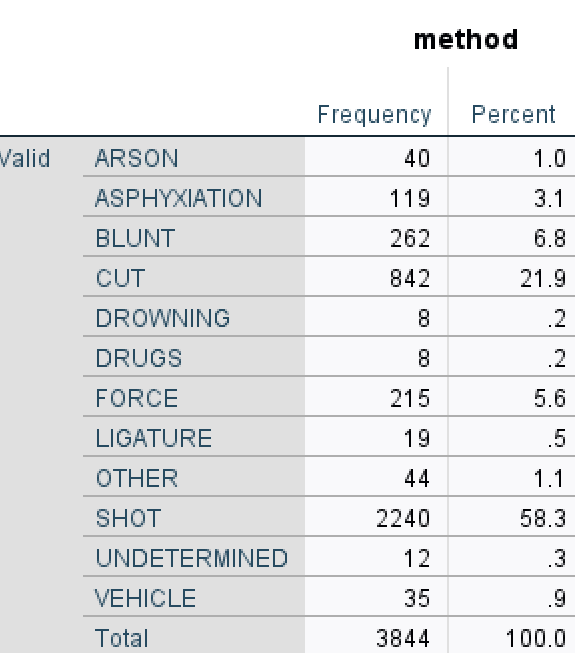
I happen to have data for nearly every NYC murder and every gunshot victim from 2010 through part of July 2020. This is an unusual (but useful) “total universe” in that to be on this list, you have to have been shot, live or die (n = 15,662) or murdered by any means (n = 3,844).
If you can get me this NYPD data from July 2020 to the present or just for any other city, it would be greatly appreciated. Just scrub the names. All the variables I want are date, method, shooting, murder, dead, and gun (last two redundant but good for error checking).
Of NYC murders, 58% were shot. This means 42% were not shot. No gun was involved. 22% were stabbed. 12.4% were beaten in some manner. 3% were asphyxiated.
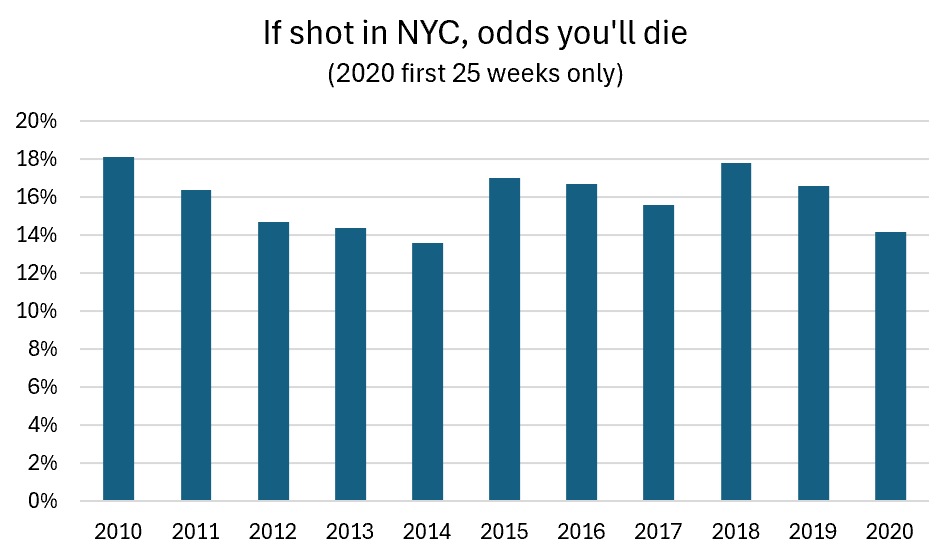
From 2010 to 2020, there don’t seem to have been any major advances saving lives of gunshot victims.
Again, maybe there have been advancements and other counter factors. But either way, it doesn’t seem like a big deal.
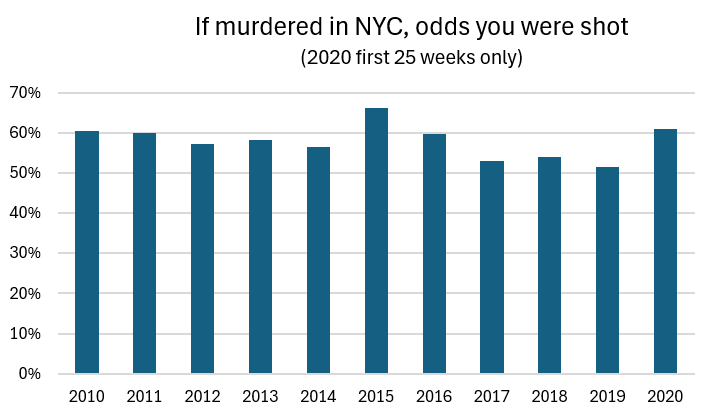
Nor did the odds your murder was by gun change much over the decade. Though I do know that the percentage by gunshot increased in 2020 (which is barely shown here on data that only covers the half of the year, and much of that before the big 2020 spike in violence).
I wrote about this a bit back in 2014 when I came up with the chart. This is for NYC.
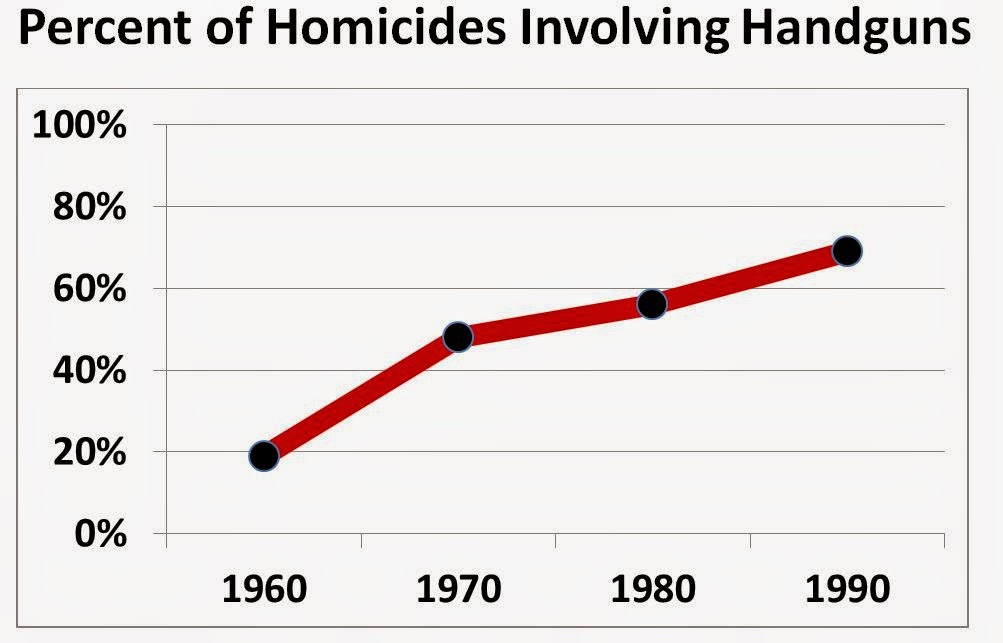
So basically it’s been consistent since 1980. And it’s always been higher outside in NYC (“It” being the percent of murders committed with a gun), estimated to be two-thirds in 1969 and roughly the same in 2011. Though now it is up to 80 percent, nationwide. The big rise in guns happened in the mid and late 1960s, when criminals started using guns more in robberies and crime and riots scared a lot of people into buying guns.
(Source: NYPD, if not cited otherwise)