Murders down in 2025! Celebrate. It’s hard work, not a “trend”
Chicago and Baltimore have seen a massive reduction in murders. Most cities have seen reductions, albeit not of such magnitude.
Chicago had 416 murders in 2025, down 27% from the prior year and down 48% since 2021.
Baltimore had 133 murders in 2025, down 34% from the prior year, and an amazing 60% since 2022.
D.C. saw a 33% reduction last year, down 44% since 2021.
New York City saw a 20% reduction in 2025, down 37% since 2022.
Jackson, Mississippi, a little city with a big murder problem, saw 63 murders last year — a terrible number for a city of 150,000 — but a vast improvement from bloody 2021, when 160 people were murdered.
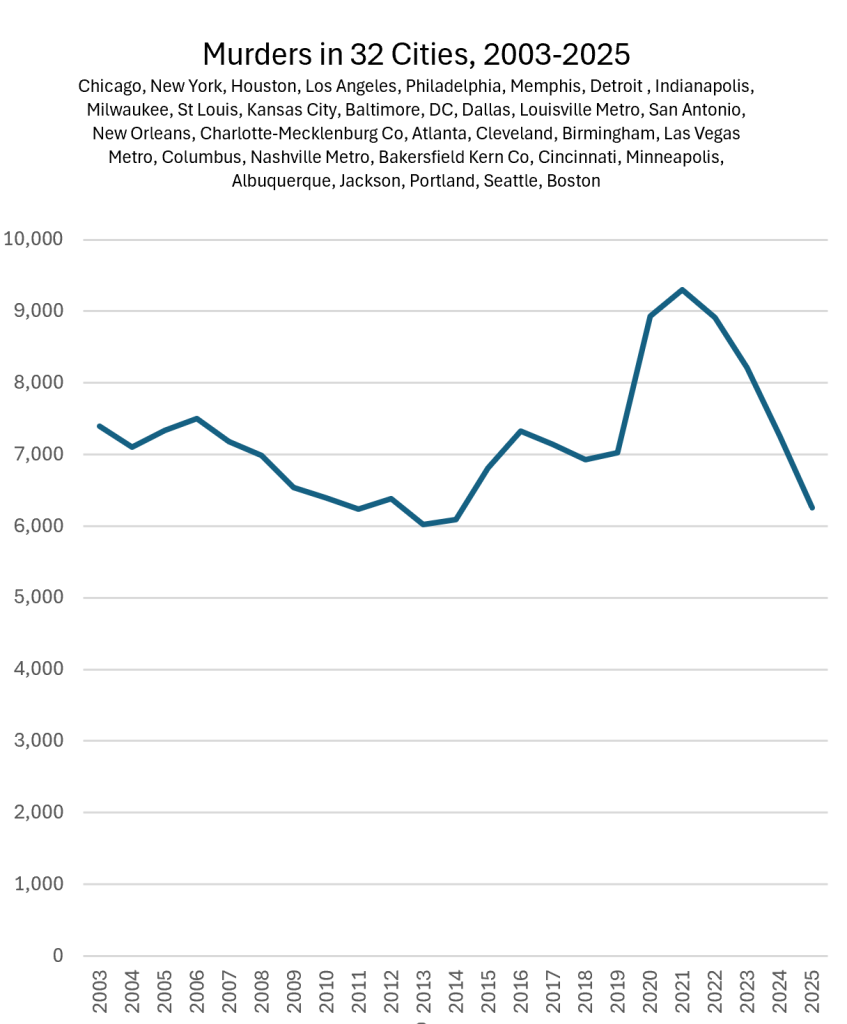
In 37 cities I could reasonable check in in the first few days of January, murders are down 18% in 2025. That’s a huge drop. But it also means we are just back to where we were in 2014. So… Mazel tov? Hopefully next year the declines will continue. Still, down is much better than up. And this is a huge decline. But is it a “trend”? Statistically, sure. But what does that mean?
Violence in Chicago does not go down because of crime fighting efforts in Baltimore. And when people speak of national “trends,” they tend to dismiss the very real hard work and collaboration of police, prosecutors, and even community organizations. There’s no national “wave” to coast on. All crime is local. None of this is inevitable. Were it, once would be hard pressed to explain why some cities buck the “trend.”
Murders stayed basically constant in Boston, Cincinnati, Oklahoma City, and St. Louis, and increased in Milwaukee and Bakersfield.
Even with violence down in most cities, in the 37 cities I looked at, only six have fewer murders than a decade ago. Those six, Baltimore, Boston, Chicago, Cleveland, Detroit, and Philadelphia, are at multi-decade lows in murders. Respect.
So what is going on? In some ways it’s like any hometown sports team. Some teams make better trades, get a better manager, train harder, have better equipment, better players, and a larger payroll and a better fan base. But unlike sports, in crime prevention every team can win! It’s a tough game to play, but it’s not a competition.
The work in each city is different, but successful crime reduction always has certain key components. It is impossible to quantify which elements work, when, and why, but all successes involve better policing, better prosecution, and a focus on repeat violent offenders. Equally important is collaboration both within and between government and community organizations. It’s hard work, but it doesn’t require an advanced degree.
Baltimore and Chicago saw crime reductions as soon as incompetent prosecutors were replaced with prosecutors more eager to prosecute criminals. How much do prosecutors matter? More and more than I used to think, that’s for sure. And why wouldn’t they? And while it’s great Chicago is back to lower levels violence. It’s still the murder capital of America. And smaller than Los Angeles and New York and not much bigger than Houston.
Philadelphia has reduced violence with a progressive prosecutor. (I honestly have little idea what has been going on in Philadelphia — there are only so many cities I can follow — but keep up the good work!)
Baltimore had a new police commissioner and the Jack Maple protégé Tony Barksdale working behind the scenes. (Rest in Peace, Tony. There’s a downside to a certain kind of friendship. I had not spoken to him in years. Had we talked before he died, we could have picked up right up where we left off, talking about policing and saving lives. It was all he cared about. We were close in a certain way, ever since meeting at the crime scene of a mass shooting in Baltimore in 2001. And we spent years shouting from the Baltimore Peanut Gallery on Twitter, back when that was fun. But honestly, I never knew much about him personally, though I knew he had health issues.)
New York City has daily multi-agency meetings led by Chauncey Parker in which every single gun arrest is discussed. Who needs help? Who needs to be put away? And which agency can best deliver the message. They now have met for well over 1,000 consecutive days. I can’t prove it works… but if you think this doesn’t have violence reduction impact, I’ll think less of you.
Some of the improvement is simply because most of the country has moved beyond the moral panic of past decade, when policing was demonized as seen as something not be be improved, but to be abolished, or at least effectively neutered. This was a lethal mistake, disproportionately affecting black men in cities which are disproportionately white such as Austin, Minneapolis, and Portland.
Police can’t do it alone. But it can’t be done without policing. City after city with a crime decline has seen arrests increasing. Arrests are a horrible measure of good policing. But they are a decent proxy that some policing is going on.
I can’t look at every city, but for those I did, a crime decline always correlates with more arrests, at least since 2021. Some of that is, as they say, nature healing. But this bucks, for better or worse, a multi-decade decline in arrests. Generally, at least since 2015, when police activity goes down, crime goes up. And vice versa.
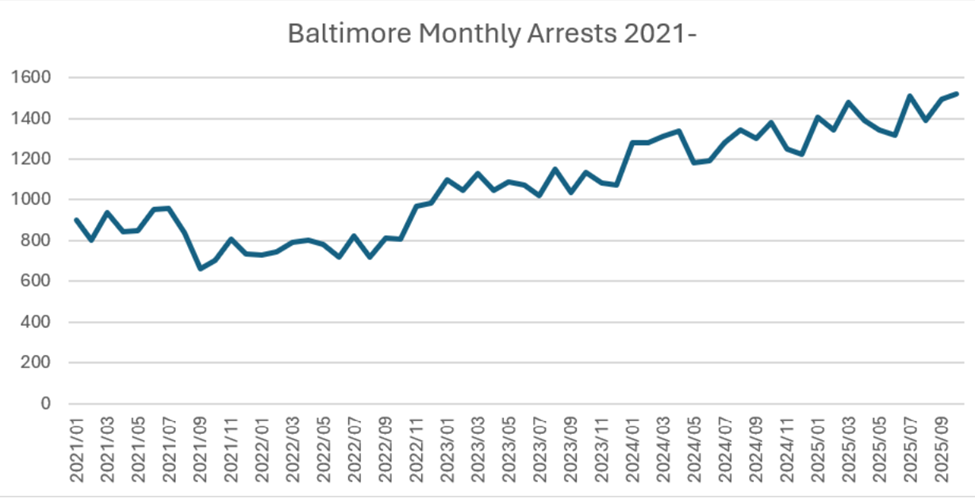
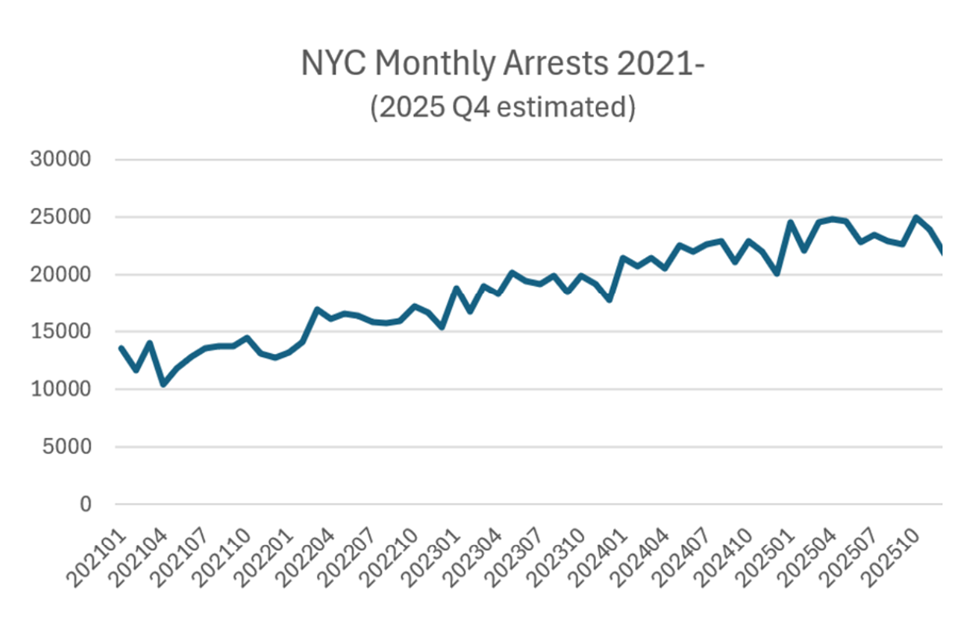
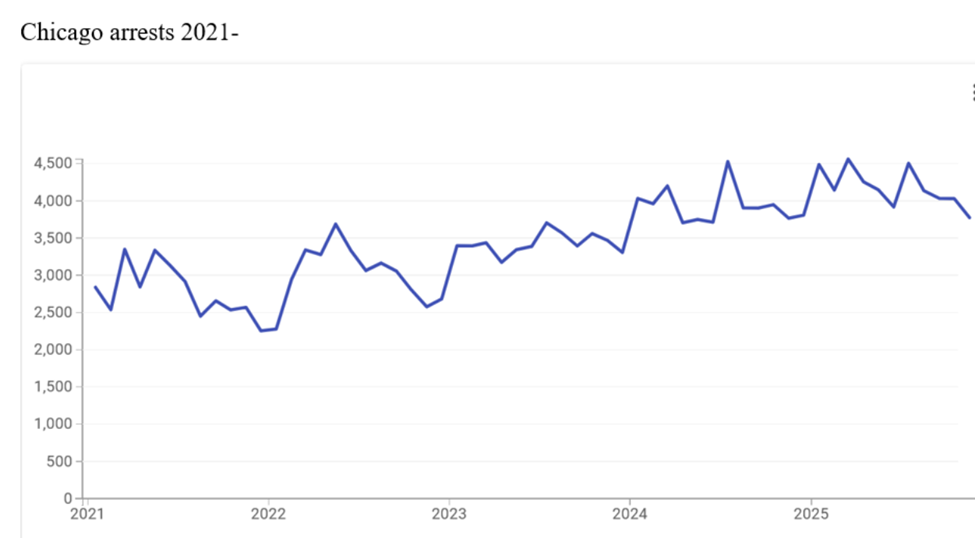
It’s really important to note that while arrests have been increasing in the these since 2020, they’re well below what they were 10 years ago. So we’re doing more crime fighting with fewer arrests! It’s not simply that more arrests are better. You need to arrest the right person. The one who is hurting other people again and again.
Here’s the same arrest data, but going back a decade:
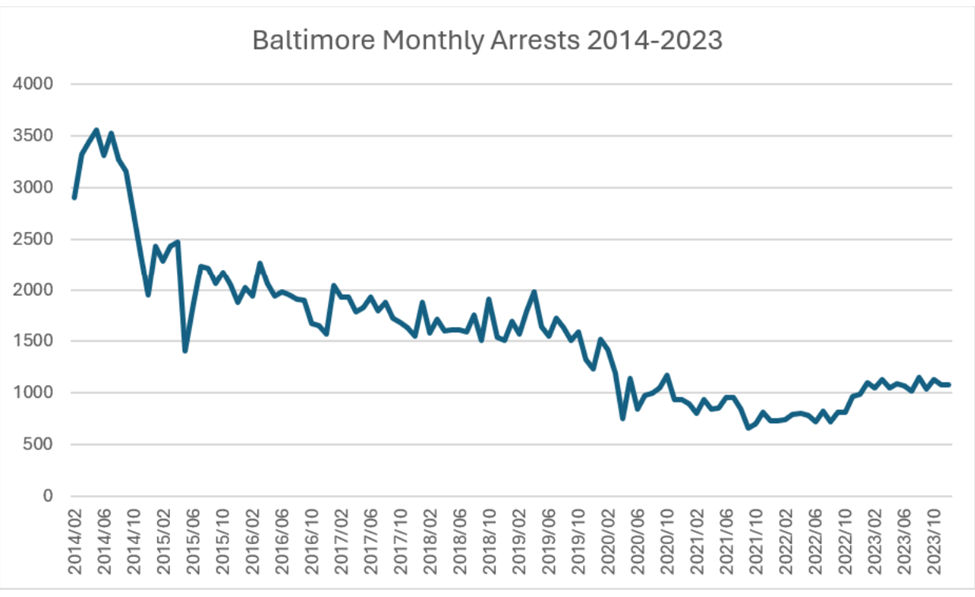
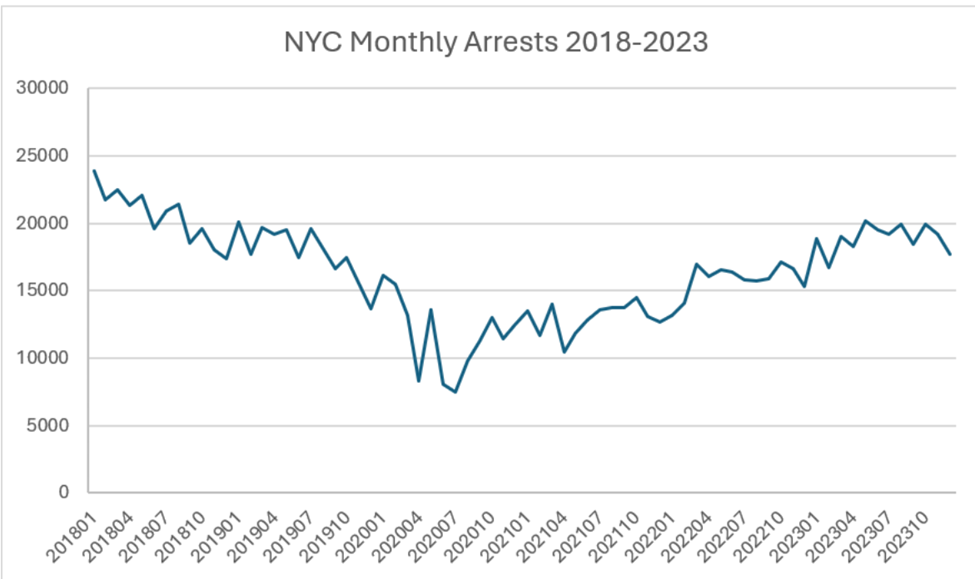
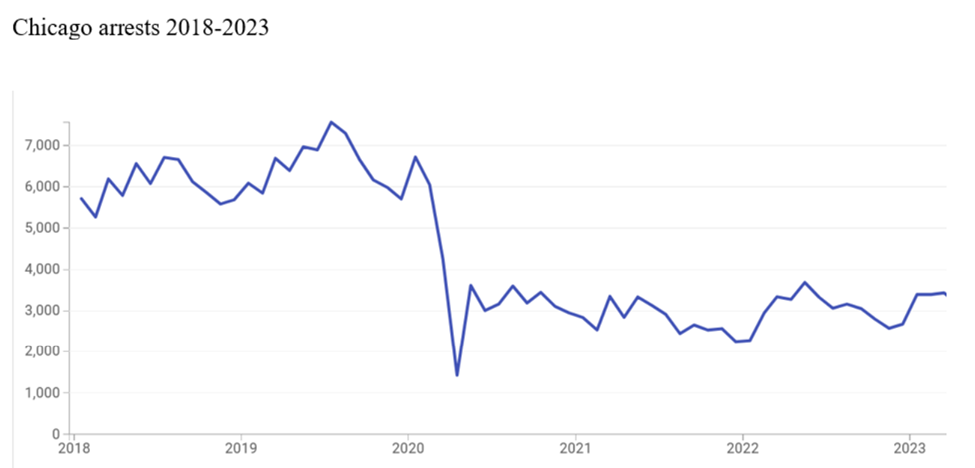
There were once too many arrests. For years, with the war on drugs, people were arrested who didn’t need to be. Not that they were innocent. But not for public safety. We know this now. And then for a long time both crime and arrests were going down in tandem. Win-win. And then in 2020 the system kind of broke with Covid. Police stopped policing. The courts were shut down. Jails and prisons released thousands of prisoners. Crime skyrocketed. I willing to out on limb say for a while back there, in 2020 and 2021, there were too many people who needed to be locked-up who were not. For public safety.
So what’s the moral? First stop with “we know policing doesn’t reduce crime” nonsense. Of course it does. And such ideological opposition to “the system,” when it gains traction, has lethal consequences. We also know that we don’t need to end poverty, racism, or any of the root causes to address violence. We also know that we can safely reduce arrests and incarceration from the levels of 20 years ago because we did. We also know that every city the brings down crime does it with but not only with policing. There are many other tools and tactics and teams that can and must play together. And I think we can assume that the levels of policing, prosecution, and incarceration during Covid in 2020 were too low. With violence declining in many places, the “usual suspects” are warning that arrests and incarceration are edging up, as if that’s so bad. Maybe [gasp] just maybe that is the cause.
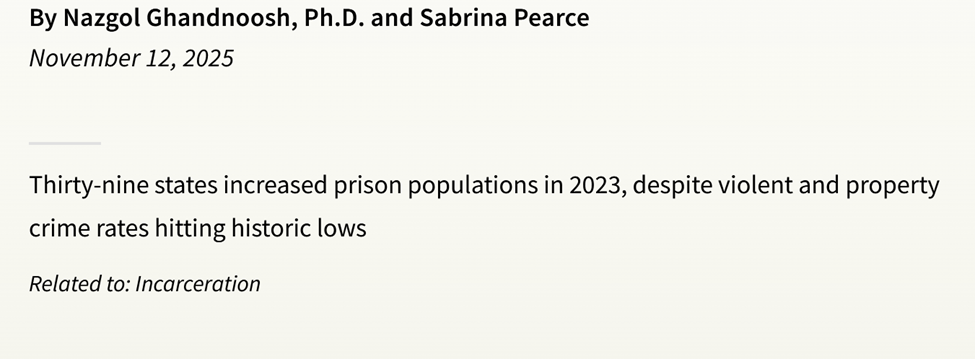
“Despite”? Maybe, perhaps “because”? I don’t know. Worth considering that some people need to be locked up because they’ve hurt somebody very badly and do so repeatedly.
Also it’s not easy to get arrest data for most cities, FWIW. I’m not cherry picking, but simply picking cities I know and for which data is available. I’d be curious to see if arrests have been more constant in, say, Milwaukee, where murders are not down (I found once source saying so, but it’s from 2024). https://www.wjiinc.org/blog/report-shows-sharp-decline-in-milwaukee-arrests